


Advanced Writing I. - Notwithstanding (CAE, CPE, IELTS)


Hello Dear,
Before you start scrolling, here is a quick info box on what you will find in this post:
some pep talk about writing in English (no, it shouldn't hurt)
some pep talk about your own voice (yes, it isn't only crucial to find it but also so incredibly worth it! YOU are worth it!)
a very odd formal & academic word: 'notwithstanding' (often found in advanced and proficiency books) --> demystifying it step-by-step
a downloadable PDF with the information covered, a little exercise and the answer key, of course - something to take away :)
And now, let's talk ALL ENGLISH! :)
So you speak English quite competently. You watch movies, often without subtitles, you don't usually stumble when expressing yourself and often find out in conversations that you actually know a lot of words, more than you expected! Let's stop here for a second: congrats! This is truly something to be proud of; don't forget to stop sometimes and give credit to yourself! Trying is everything.
Now that you are quite good at English, perhaps you want to study abroad, move, or immigrate to a new country. How hard could it be to take and pass higher-level English language exams?
The answer is - yes and no.
Is this goal achievable? - Yes!
Do you need to study? - Also yes!:D
Should you fear it? - Absolutely not.
It shouldn't scare you and certainly shouldn't overwhelm you. However, it often happens - at least in my experience as an ESL teacher - that students have never really had to write (a lot) in English, and therefore haven't practised a lot and consequently, don't really know their own voice (in writing). Students often feel unnatural in writing, even if they are fluent otherwise. And when you feel unnatural, that usually shows.
Perhaps I have a bit of an unusual stance on this: I am an ESL teacher, but I'm also a writer and had started publishing even before I started teaching English. I know the fear and the oddness, the confusion that often goes into writing.
However, there are some things to remember about writing (in general and for exams as well):
More complicated doesn't equal better. A text isn't necessarily smart just because it sounds smart. In fact, unless you are completely sure about how to use more advanced expressions correctly, chances are, you will make mistakes and consequently lose points as well (at least, if you are taking an exam or writing a submission or an assignment). It's better to be clear, simple, and concise than to try to do language acrobatics and fall.
You need to find the writing process natural (it can only be achieved through practice, but you can get there faster than you would think). If you feel natural, you will be natural, and if you are natural, you inherently do better because you are more relaxed and confident.
Are your words serving you, or are you serving your words? - What do I even mean? This is where 'notwithstanding' comes into the picture: You shouldn't use words just because they are complicated. You should use them if they make your sentence shorter, flow better, and get straight to the point.
My dog could, for example, describe the meaning of 'dull' (with a whole sentence), but he could also just use that one word expressing the same:

And on the note of 'dull', my dog could also say this:

Voilà: energy saved! Having the right (precise word) saves you time and energy. The right expression can make your life easier. That's all.
So:
NOTWITHSTANDING.
I've recently taught a lesson about advanced and more formal words students could use in writing, and soon discovered the most challenging aspect of it; 'notwithstanding' is a chameleon as it can fulfil three different roles in a sentence. And while, in reality, you will only need one of them, it's good to know about the other two as well. Because - just as our dear Murphy and his law often like to remind us - if I didn't tell you about the other two, you would run into them, and would end up being confused. The way my students always do.
The next steps, I hope, will help you:
1.) Some grammar terms we will need ('roles' notwithstanding could fulfil in texts):
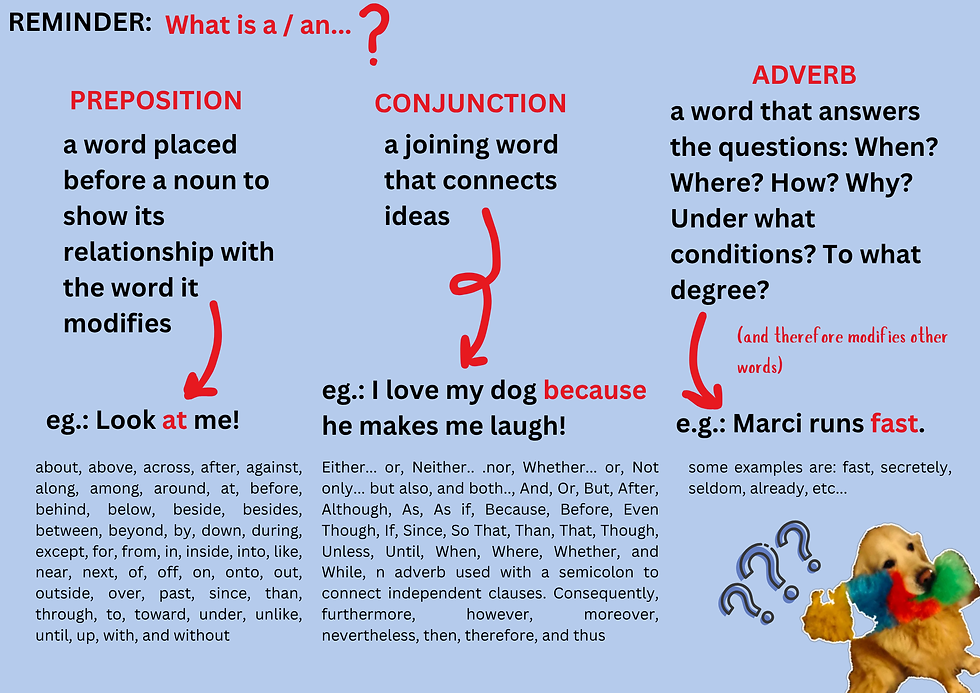
2.) To find in which sentences does 'notwithstanding' fulfils which role:

(Find the full answer key in the downloadable document at the bottom of the page!)
3.) To recognise the one and only pattern you will want to use:

4.) To do a quick quiz about the three main functions notwithstanding could carry out:

5.) To do a task about the one that matters: notwithstanding as a preposition:

This is all.:)
To get the whole worksheet and the answer key, download the following document.
(It is free and you don't have to subscribe.:))
If you want to book a lesson with me, prepare for a language exam - or get feedback on your writing in general - contact me here!:)
If you are like, 'I don't wanna write academic stuff, I wanna write fantasy!', I do have worksheets and I do coaching on writing fantasy, poetry, and creative writing in general. - Contact me anyway!

Last but not least, for resources:
If you want a good page to dive more into grammar terms, go here - I used it as a resource too: https://www.luc.edu/literacy/tutoring/basicgrammarterms/
Stay strong, you've got this!
Best,
The Fearless Frock


Comments